
Protein Molecular Weight Markers

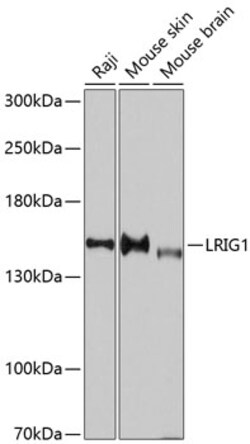
ABclonal Technology LRIG1 Rabbit pAb

Predicted to act upstream of or within several processes, including innervation, otolith morphogenesis, and sensory perception of sound. Predicted to be located in plasma membrane. Predicted to be active in extracellular matrix and extracellular space.

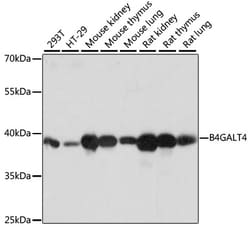
ABclonal Technology B4GALT4 Rabbit pAb
This gene is one of seven beta-1,4-galactosyltransferase (beta4GalT) genes. They encode type II membrane-bound glycoproteins that appear to have exclusive specificity for the donor substrate UDP-galactose, all transfer galactose in a beta1,4 linkage to similar acceptor sugars GlcNAc, Glc, and Xyl. Each beta4GalT has a distinct function in the biosynthesis of different glycoconjugates and saccharide structures. As type II membrane proteins, they have an N-terminal hydrophobic signal sequence that directs the protein to the Golgi apparatus and which then remains uncleaved to function as a transmembrane anchor. By sequence similarity, the beta4GalTs form four groups beta4GalT1 and beta4GalT2, beta4GalT3 and beta4GalT4, beta4GalT5 and beta4GalT6, and beta4GalT7. The enzyme encoded by this gene appears to mainly play a role in glycolipid biosynthesis. Two alternatively spliced transcript variants have been found for this gene.
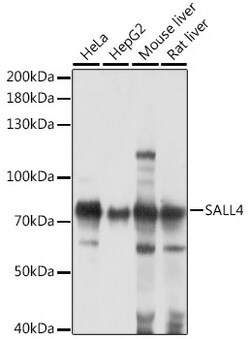
ABclonal Technology Sall4 Rabbit pAb
This gene encodes a zinc finger transcription factor thought to play a role in the development of abducens motor neurons. Defects in this gene are a cause of Duane-radial ray syndrome (DRRS). Alternative splicing results in multiple transcript variants encoding different isoforms.
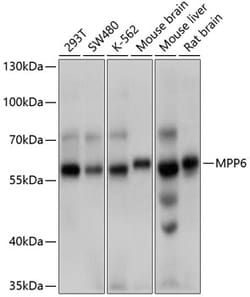
ABclonal Technology MPP6 Rabbit pAb
Members of the peripheral membrane-associated guanylate kinase (MAGUK) family function in tumor suppression and receptor clustering by forming multiprotein complexes containing distinct sets of transmembrane, cytoskeletal, and cytoplasmic signaling proteins. All MAGUKs contain a PDZ-SH3-GUK core and are divided into 4 subfamilies, DLG-like (see DLG1, MIM 601014), ZO1-like (see TJP1, MIM 601009), p55-like (see MPP1, MIM 305360), and LIN2-like (see CASK, MIM 300172), based on their size and the presence of additional domains. MPP6 is a member of the p55-like MAGUK subfamily (Tseng et al., 2001 [PubMed 11311936]).
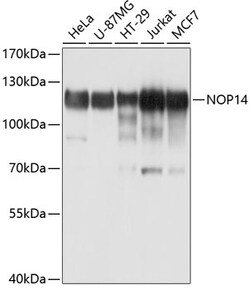
ABclonal Technology NOP14 Rabbit pAb
This gene encodes a protein that plays a role in pre-18s rRNA processing and small ribosomal subunit assembly. The encoded protein may be involved in the regulation of pancreatic cancer cell proliferation and migration. Alternative splicing results in multiple transcript variants.
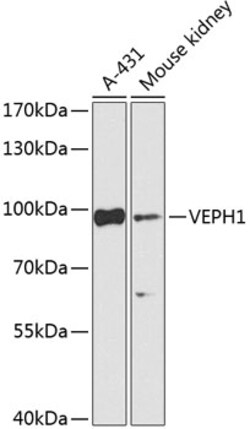
ABclonal Technology VEPH1 Rabbit pAb
Predicted to enable phosphatidylinositol-5-phosphate binding activity. Involved in negative regulation of SMAD protein signal transduction and negative regulation of transforming growth factor beta receptor signaling pathway. Predicted to be active in plasma membrane.
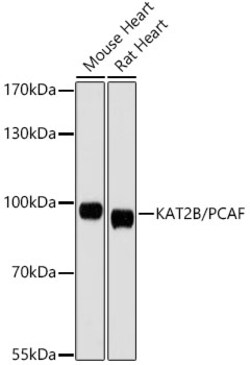
ABclonal Technology KAT2B/PCAF Rabbit pAb
CBP and p300 are large nuclear proteins that bind to many sequence-specific factors involved in cell growth and/or differentiation, including c-jun and the adenoviral oncoprotein E1A. The protein encoded by this gene associates with p300/CBP. It has in vitro and in vivo binding activity with CBP and p300, and competes with E1A for binding sites in p300/CBP. It has histone acetyl transferase activity with core histones and nucleosome core particles, indicating that this protein plays a direct role in transcriptional regulation.
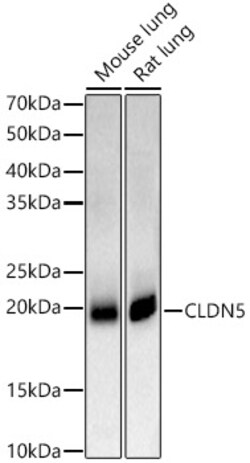
ABclonal Technology CLDN5 Rabbit pAb
This gene encodes a member of the claudin family. Claudins are integral membrane proteins and components of tight junction strands. Tight junction strands serve as a physical barrier to prevent solutes and water from passing freely through the paracellular space between epithelial or endothelial cell sheets. Mutations in this gene have been found in patients with velocardiofacial syndrome. Alternative splicing results in multiple transcript variants encoding distinct isoforms.

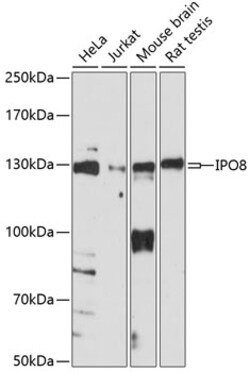
ABclonal Technology IPO8 Rabbit pAb
The importin-alpha/beta complex and the GTPase Ran mediate nuclear import of proteins with a classical nuclear localization signal. The protein encoded by this gene is a member of a class of approximately 20 potential Ran targets that share a sequence motif related to the Ran-binding site of importin-beta. This protein binds to the nuclear pore complex and, along with RanGTP and RANBP1, inhibits the GAP stimulation of the Ran GTPase. Alternatively spliced transcript variants encoding different isoforms have been found for this gene.
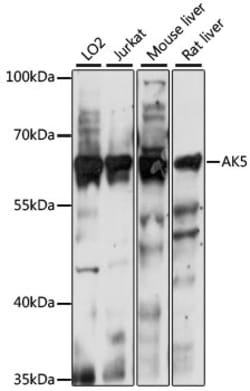
ABclonal Technology AK5 Rabbit pAb
This gene encodes a member of the adenylate kinase family, which is involved in regulating the adenine nucleotide composition within a cell by catalyzing the reversible transfer of phosphate groups among adenine nucleotides. This member is related to the UMP/CMP kinase of several species. It is located in the cytosol and expressed exclusively in brain. Alternatively spliced transcript variants encoding distinct isoforms have been identified for this gene.
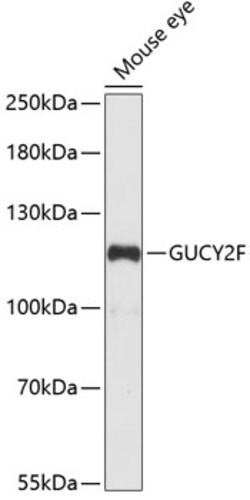
ABclonal Technology GUCY2F Rabbit pAb
The protein encoded by this gene is a guanylyl cyclase found predominantly in photoreceptors in the retina. The encoded protein is thought to be involved in resynthesis of cGMP after light activation of the visual signal transduction cascade, allowing a return to the dark state. This protein is a single-pass type I membrane protein. Defects in this gene may be a cause of X-linked retinitis pigmentosa.
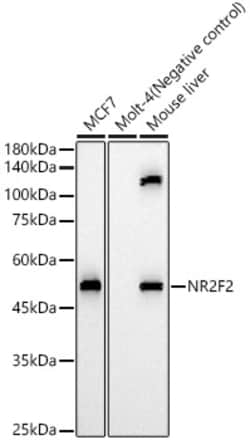
ABclonal Technology NR2F2 Rabbit pAb
This gene encodes a member of the steroid thyroid hormone superfamily of nuclear receptors. The encoded protein is a ligand inducible transcription factor that is involved in the regulation of many different genes. Alternate splicing results in multiple transcript variants.
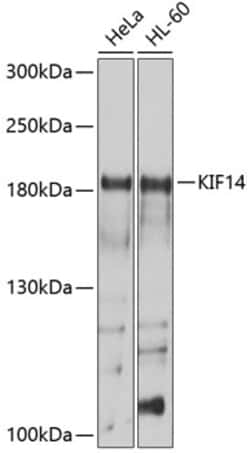
ABclonal Technology KIF14 Rabbit pAb
This gene encodes a member of the kinesin-3 superfamily of microtubule motor proteins. These proteins are involved in numerous processes including vesicle transport, chromosome segregation, mitotic spindle formation, and cytokinesis. In human HeLa-S3 and 293T cells, this protein is localized to the cytoplasm during interphase, to the spindle poles and spindle microtubules during mitosis, and to the midbody during cytokinesis. An internal motor domain displays microtubule-dependent ATPase activity, consistent with its function as a microtubule motor protein. Knockdown of this gene results in failed cytokinesis with endoreplication, which results in multinucleated cells. This gene has been identified as a likely oncogene in breast, lung and ovarian cancers, as well as retinoblastomas and gliomas. Alternative splicing results in multiple transcript variants.
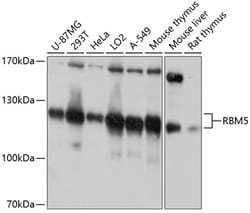
ABclonal Technology RBM5 Rabbit pAb
This gene is a candidate tumor suppressor gene which encodes a nuclear RNA binding protein that is a component of the spliceosome A complex. The encoded protein plays a role in the induction of cell cycle arrest and apoptosis through pre-mRNA splicing of multiple target genes including the tumor suppressor protein p53. This gene is located within the tumor suppressor region 3p21.3, and may play a role in the inhibition of tumor transformation and progression of several malignancies including lung cancer.